The Still, Small Voice Within
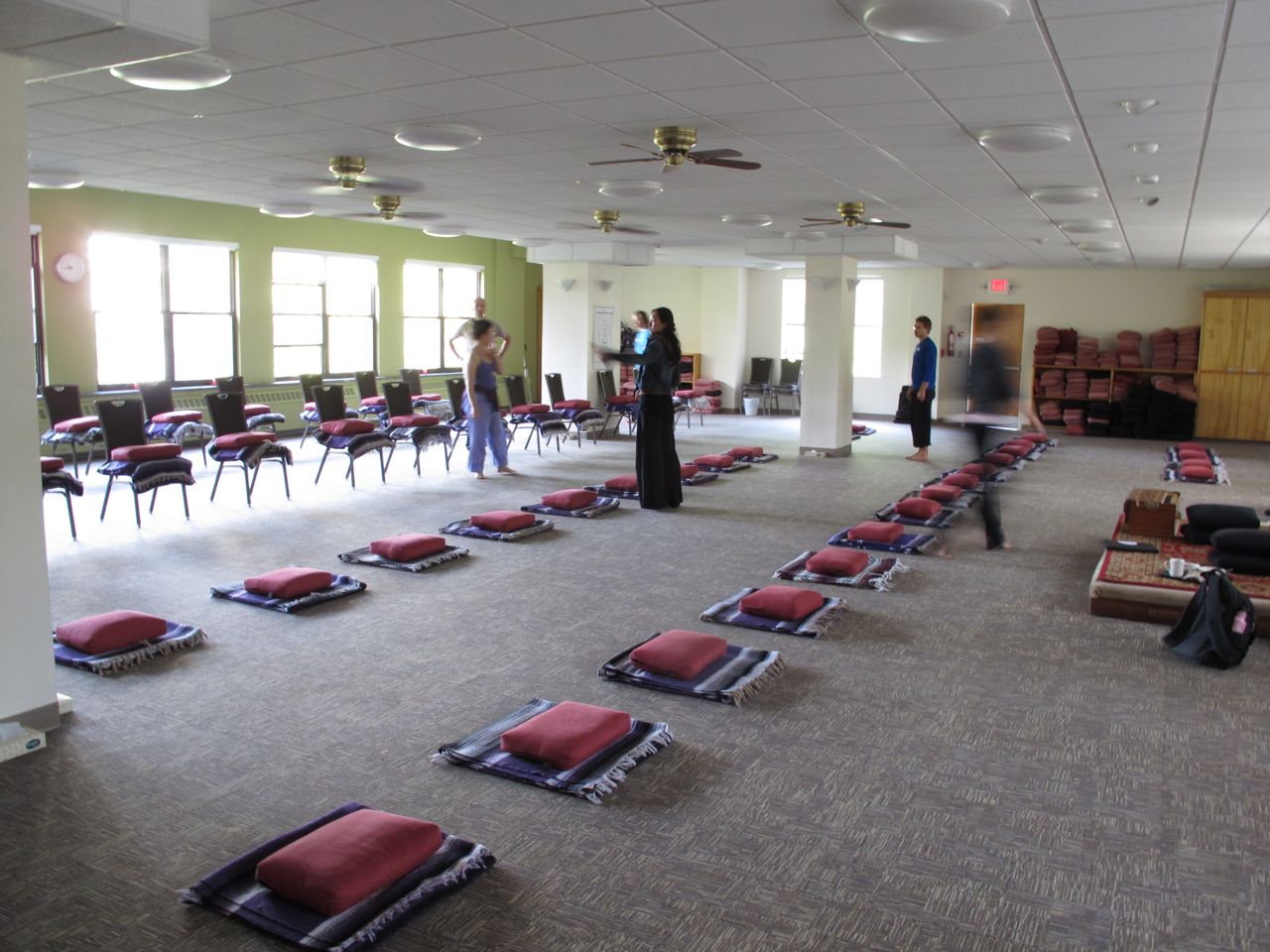
It's been eight straight days of programs here at Kripalu Center.
When I moved up here from our funky ashram in Pennsylvania in 1983 I thought the building was either a prison or a hospital. Turns out it was something in between. After 23 years of total immersion, I now return five or six times a year to lead retreats and trainings. (Before we took it over, this facility was a Jesuit training center which they never filled, failing to anticipate the 1960's.)
The first program, "The Still Small Voice Within: Meditation, Focusing and Intuition Training," is five days of settling, sensing and inner listening. A big component of the program includes speaking and attempted to describe that which is just coming in awareness. Paying attention in the spirit of meditation means we become aware of things we were not aware of before. Describing our inner experience can help us clarify what's coming to the surface. Sensing, inner listening, speaking, deep listening, all in an environment of social silence, good people and a healing environment led to a wonderful sense of shared intimacy.
I then launched into "The Energy Intensive: Meditation, Yoga and Breathwork" with my fellow leader, Shobhan Richard Faulds. This was three days, starting at 6:00AM and ending at 9:00PM. While we explore social silence and 'settling practices' in this program we also move a lot of energy through movement, relaxation, meditation and breath. The practice here is raising both "prana" and "chitta," or energy and awareness. We do a powerful breathwork practice which releases deep-seated tensions and opens all kinds of new possibilities.
I'm always inspired by how quickly a group of strangers can come into a palpable sense of community.
On to Maine to visit my folks.
Notes on Compassion
Post NPR
I used to have a 'ten minute rule', which changed my life in a most positive way. Whenever I had to be anywhere, I planned on being ten minutes early. I found it quite calming. Since moving to the DC area. though, I've had to up that to a 'twenty-minute rule' to accommodate the gnarly traffic here.
I made sure to get in early for the recording at WAMU with Diane Rehm and guests. Once I got parked and buzzed in and landed in the waiting room I was offered water or coffee. Out of nervousness I agreed to the coffee.
I didn't count on it being so strong and while I wasn't quite hyperventilating before the red light came on, I felt 'rather jazzed'.
When the first question was directed to me I got to watch the effect of adrenalin moving through my body at the same time as I started making noises and moving my lips. That was a rush.
Thankfully I settled down.
If you'd like to listen to the hour-long show or just catch the first few minutes of my rather flustered response,you can click here.
They had a flood of calls and emails, which felt quite gratifying.
Tuesday on the Diane Rehm Show
This Tuesday, June 22nd, I'll be on the Diane Rehm Show with Richie Davidson, PhD, who teaches at the University of Wisconsin and has overseen ground-breaking research in meditation and Josephine Briggs, MD, the director of the NIH National Center for Complementary and Alternative Medicine. The topic is "The Power of Meditation."
In 1973, a housewife named Diane Rehm arrived to volunteer on WAMU's The Home Show. Today, that one-time volunteer has a worldwide audience of more than 2.2 million listeners and hosts a show that is heard on more than 150 public radio stations nationwide, Sirius XM Satellite Radio, NPR World Wide, and Armed Forces Radio Network.
Images from the Week
Hang around long enough and something's gonna happen. We were meditating in the early evening by the river and noticed a deer swimming across the Potomac. It's a pretty grainy shot, but you can see the antlers off to the left. It's not unusual to be kayaking in the Potomac and see deer hanging out on the islands.

And early, early in the morning, a Great Blue caught mid-launch. This is a spontaneous reaction shot, but I really enjoy how the image captures the silhouette of the legs and feet - plus the framing, depth and mood.
I'm always on the lookout for the first signs of the next season. No sign of fall yet, as the greens are still intense and vivid right now.
This week I did some video recording at the World Bank on instruction and training in mindfulness practices. After we laid down the audio, some brave volunteers came in for some shooting for cutaway shots. I appreciate the challenge of making a video series during which the viewer is instructed to close their eyes.
That's me in the foreground, comfortably nestled in Final Cut Pro while the director makes some adjustments on the set.
On Fear, with Visuals
BuddhaFest Flashmob
Flashmob! A number of meditators gathered together in downtown DC ...
[youtube]W1Of5NN5aq4[/youtube]
The BuddhaFest Film Festival is coming to DC soon!
A Masterpiece in Minutes
Tibetan sand mandala time lapse [youtube]ur59ZYXEVgc[/youtube]
(Thanks, Christa and Jane)
Images from the Week
There's a reason photographers get up and out early. The low morning light can dramatically bring out textures and amplify colors. Here are a few shots from this last week from early in the morning. Some mornings you can watch the sun burning off the haze. Sunday was particularly dramatic.
Closer in ...
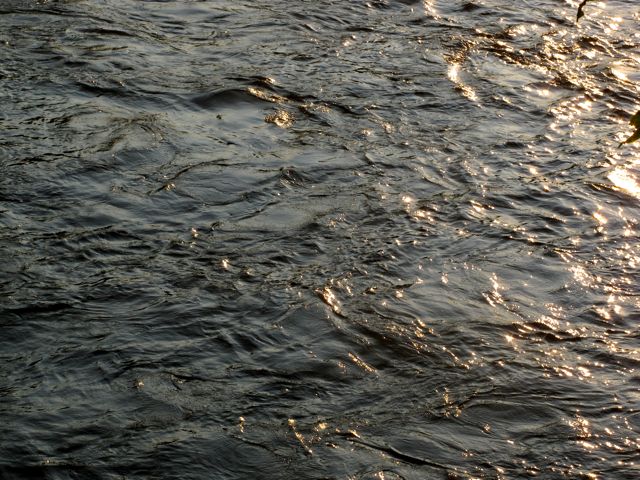
The Potomac can appear quite placid, yet the low morning light shows just how much is going on on and below the surface.
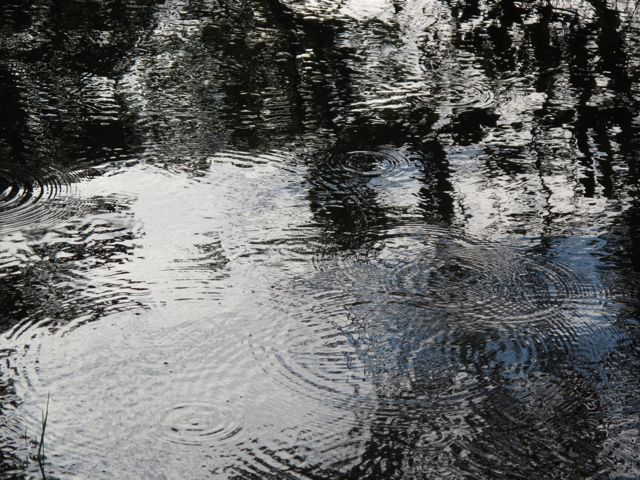
A spring and a small pond in the meadow. A light drizzle, frogs and water bugs keep the surface in constant motion.
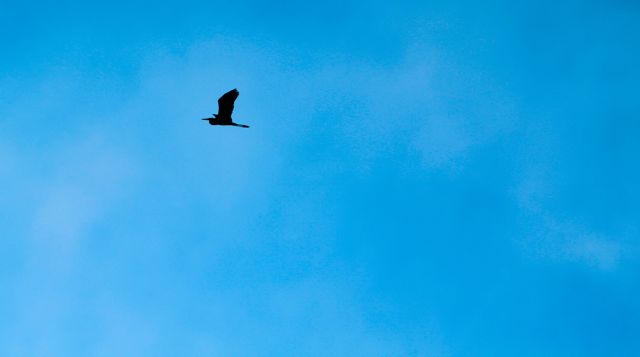
River Bend is just up-river from a heron rookery. Here's a heron on it's morning commute.
Happy for No Reason: Kung Fu Bear
A bear in a Japanese zoo has developed some pretty interesting skills. The power of play ... [youtube]ejNy8xbj2fc[/youtube]
(Thanks, Mark.)
More on Snowball
You may recall a "Happy for No Reason" video I posted of Snowball, who loves moving to music with a beat. [youtube]N7IZmRnAo6s[/youtube]
That video prompted Anniruddh Patel, a neuroscientist, to explore music's hold on the brain. Do we have a neurological relationship to music, as we do language? Fascinating stuff.
You can read more through this recent New York Times article.
The Empathic Civilization
The discovery of mirror neurons and the drive to belong. [youtube]l7AWnfFRc7g[/youtube]
(Thanks, Judith.)
Images from the Week
With the new hot weather come the bugs. A shot from this morning of the ubiquitous waterbugs.

Riverbend Park floods easily, which makes the area so diverse and rich in strange and unusual flora and fauna. But just below Riverbend one comes to Great Falls, which is granite.
A shot here of what grows around the crystal-embedded granite. I love the textures.
BuddhaFest
The first annual DC Buddhafest begins is a few weeks. A collection of films, talks, discussion groups and gatherings begins on June 17th.

More on BuddhaFest here.
Yoga and Meditation
Time was when traditions were quite separate. There was little cross-pollenation. The American way of 'using what works' has changed all that. The traditions of yoga and meditation inform each other in powerful ways. I meet many people who say, "I love yoga, but hate meditation," and vice versa. I'm excited to see how movement and stillness practices influence each other and open up new worlds.
The Kripalu Center training we just completed honors how important it is to find balance between energy and awareness (sanskrit words, 'prana' and 'chitta.') Sometimes we need to move energy. Sometimes the most balancing thing is to focus and calm the mind, gathering your attention in one place.
Teaching Meditation
I'm up at Kripalu Center for Yoga and Health for ten days, part of the 500-hour Advanced Yoga Teacher Training. This module focuses on teaching meditation. We've got 51 sincere, adventurous participants here, many cooking in their own juices while we explore different meditation techniques and their effect on body, mind and spirit. Part of this training is a four-day retreat jammed with experiences - and to make things more fun, we're in social silence until we start practice teaching.
As anyone who meditates knows, when you pause, slow down and start paying attention, everything undigested in your life starts to come to the surface.
As much as I like people to like me, I'm strangely comfortable with the discomfort in the room. We're experiencing infinite variations of the hindrances: anger, blame, judgement, craving, planning, fantasy, anxiety, sloth, numbness, doubt, fear, grieving, shame and more. As much as I try to keep setting the context, I still get glaring looks from time to time.
I guess it's because I've personally burned through so much on the meditation cushion that I can be so spacious. If they still don't like me by the time they leave, then maybe it really is me!
Shunryo Suzuki speaks of four race horses.
He says:"It is said that there are four kinds of horses: Excellent ones, good ones, poor ones, and bad ones. The best horse will run slow and fast, right and left, at the driver's will, before it sees the shadow of the whip. The second best will run as well as the first one, just before the whip reaches its skin. The third one will run when if feels pain on its body, and the fourth will run after the pain penetrates to the marrow of its bones. You can imagine how difficult it is for the fourth one to learn to run."
When we hear this story, almost all of us want to be the best horse. If it is impossible to be the best one, we want to be the second best. But this is a mistake, Master Suzuki says. When you learn, you're tempted not to work hard, not to penetrate to the marrow of a practice.
The best horse, according to Suzuki, may be the worst horse. And the worst horse can be the best, for if it perserveres, it will have learned whatever it is practicing all the way to the marrow of the bones.
And in my opinion, the worst horses make the best teachers.
Gladdening the Heart
The Buddha talked about 'gladdening the heart' as a way to cultivate a more awakened heart and mind. Here's how one five-year old starts her day: [youtube]qR3rK0kZFkg[/youtube]
Images from the Week
I'm heading up to Kripalu Center for Yoga and Health to co-lead a nine-day training in teaching meditation for their 500-hour professional level Yoga Teacher Training program. I got a late start and driving up the eastern seaboard at the wrong time resulted in hours of images pretty much like this:

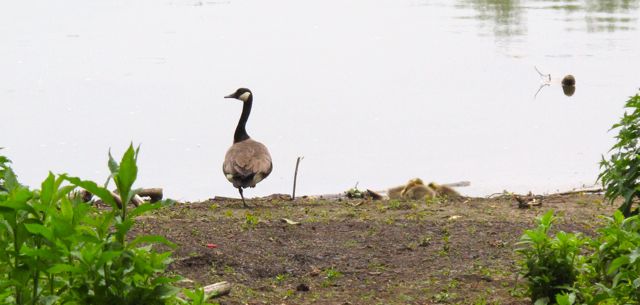
But before I left I loaded the dogs in the car and drove to the river, hoping to hang out with the goslings who've just arrived. I got there before they woke up and watched them enter a new day. As it was a cool morning, the goslings were huddled up in a pile with attentive adult supervision.
Something woke them up.
After a little stretching it was time to enter the day.
Finally, some hallucinogenic-looking ferns I saw on on the way home.
Clearing a Space
Our Year of Living Mindfully program had it's first monthly class at our house this Wednesday night. Toward the end of the evening all the lights went out. We sat in meditation for a bit and I hoped the power might come back on. We're at the end of a private lane and any power outage anywhere in the system affects us. The lights never did come on, so aided by candles and cell phones and flashlights, folks gathered up and headed out. Ten minutes later I got a call that a tree was down on the road and cars on both sides were unable to pass.
My chance to be a hero! I tossed my new Stihl chainsaw in my car and headed out, envisioning myself trotting up with a running chainsaw and making short order of the tree, liberating everyone to their destinies.
I got there just as the police did and was informed that the lines were hot and we had to wait for the power company.
Wait we did. Hours.
Right now in the program we are diving into the modality of Focusing as a way to deepen attention to the 'felt sense' of the body. This training is enormously helpful in shifting from how we think about something to how it feels inside, allowing a practitioner to more quickly get in touch with any issue.
The first step is called "Clearing a Space." The questioner asks a question such as, "What's between me and feeling really good inside?"
Upon naming an issue, the questioner says hello to it, senses it and places it to the side for later reflection. The process continues until there's a sense of completion.
Once one has identified the landscape of issues, the practitioner then starts to focus on the 'felt sense,' how and where it lives inside.
As we were horsing around waiting for the power company tree crew to show up, Catherine got a great shot with her iphone which kind of ended up looking like a movie poster. Here it is:
I never thought of Focusing with a chainsaw metaphor, but I kind of like it.